

Is Your Brand Voice Too Perfect to Be Believable?
In 2009, Domino’s Pizza ran advertising that most companies would have rejected in horror.
Their CEO looked directly into the camera and said their pizza wasn’t good enough.
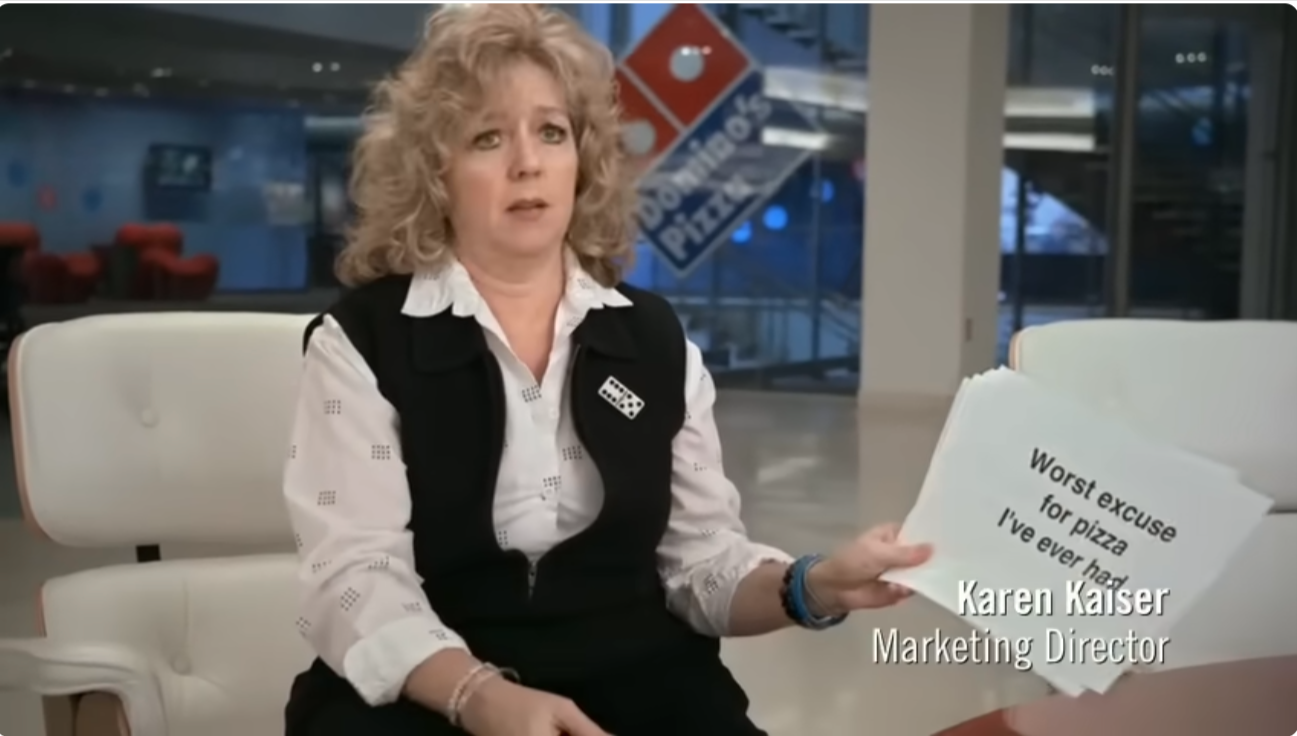
Customers were shown in focus groups on screen describing the crust as cardboard, the sauce as ketchup, the cheese as rubbery. One woman asked “where’s the love”?
Domino’s didn’t soften the language or reframe the criticism. They owned up and put it in their ads, verbatim, being direct with viewers that they were starting over.
It was a bold move, but it paid off.
Credit: Domino’s® Pizza Turnaround – Youtube
The pizza was reformulated, but not dramatically. What really changed was the brand perception because when Domino’s admitted the gap between their claims and their reality, people respected the radical honesty.
The stock price rose 30% over the following year. The campaign is now studied in business schools as one of the most commercially effective brand interventions in the restaurant sector’s recent history.
The mechanism at work wasn’t novelty. It was the Pratfall Effect: the psychological finding by Elliot Aronson that competent people become significantly more trusted when they demonstrate a specific, honest flaw.
The flaw doesn’t undermine the competence. It makes the competence believable.
Brands that have invested in too much brand polish, tightly controlled voice guidelines, professionally produced content, coherent visual systems, often face an unexpected version of this problem.
Not that their brand is bad, but that it’s too smooth. Every claim is optimized. Every image is aspirational. Every case study presents an unbroken trajectory from challenge to success.
But buyers know that commercial reality is messier than this, and naturally start to question whether they’re reading a brand or a brochure.
Why Calibrated Imperfection Builds More Trust Than Polish
The Pratfall Effect operates under a specific condition: the imperfection must be minor relative to an established baseline of competence. A CEO who trips over their words while describing brilliant strategic thinking becomes more likeable. A CEO who trips over their words while failing to describe any strategic thinking at all becomes less credible.
This is the constraint that makes the principle commercially useful rather than simply interesting. It doesn’t mean introduce flaws randomly. It means identify the places where honest acknowledgment of limitation — a constraint in what you do, a condition under which your approach works best, a client situation that isn’t a fit — would make every other claim more believable.
In B2B, the most commercially valuable version of this is specificity about who you’re not for. A company that claims to serve everyone is, at some level, claiming something that sophisticated buyers know can’t be true.
A company that describes its ideal engagement profile — the type of problem, the type of client, the conditions that produce the best outcome — is implicitly admitting that other configurations don’t work as well. That admission is a trust signal, not a weakness.
Ramboll, the engineering consultancy, built significant credibility in environmental and water infrastructure by maintaining a disciplined focus on specific project types. Their positioning didn’t try to cover all of civil engineering. When prospective clients encountered that specificity, it read as depth rather than limitation — because knowing what you’re best at implies you’ve learned something from the work you’ve done.
The most dangerous sentence in business isn’t an aggressive one. It’s the accommodating “we can help anyone” — because it tells the buyer that either the company hasn’t done the introspective work to know its own limits, or it has done that work and is choosing to obscure the results.
A brand voice that claims to be ideal for everyone is, to any serious buyer, a signal that it’s been engineered for everyone — which means it’s been optimized for no one. The places where you’re honest about your constraints are the places where your claims about your strengths become credible.
The Brand Gravity Momentum Session™ identifies where your brand voice is over-polished to the point of undermining trust — and where calibrated honesty would create stronger buyer confidence than your current positioning does.
The Uncanny Valley of Professional Brand Voice
There is a parallel phenomenon in robotics and computer animation called the uncanny valley: the discovery that humanoid figures become increasingly appealing as they approach human appearance — until they get close enough that the remaining differences become disturbing rather than neutral. The near-human figure provokes unease in a way that a clearly artificial figure does not.
Brand voices face the same problem.
A company that attempts to sound human by assembling the stylistic signals of informal communication — the casual punctuation, the conversational asides, the studied warmth — while maintaining the underlying structure of a corporate positioning exercise, produces something that registers as inauthentic precisely because it’s trying so hard not to. The voice feels engineered. And engineered warmth, to a reader who encounters a great deal of professional communication, is more unsettling than formal distance.
The issue isn’t that professional brand voices are wrong. It’s that the attempt to appear more human through surface-level informality often produces the opposite effect. Buyers who are evaluating risk in high-stakes decisions are running a constant background assessment: is this company what it says it is? A brand voice that has clearly been assembled from authenticity signals — rather than actually being the way this company thinks — fails that test.
The alternative isn’t removing the brand voice. It’s grounding it in something specific enough that it can’t easily be produced by a committee with a style guide. A genuine point of view on a contested question in the industry. An honest account of a project that didn’t go perfectly and what was learned. A position on what the company won’t do and why, described in concrete terms rather than marketing language.
These elements are harder to produce. They require the company to have actually worked out what it thinks, rather than what it wants to appear to think. But they produce brand voices that sophisticated buyers find credible precisely because they couldn’t easily have been assembled from generic brand guidelines.
Where Over-Polish Creates Commercial Friction
The commercial consequences of over-polished brand voice are specific and measurable. They appear in three areas consistently.
The case study problem. Most B2B case studies present an unbroken trajectory: here was the problem, here is what we did, here is the excellent result. Real projects don’t look like this. They involve unexpected complications, revised approaches, and outcomes that were better in some dimensions and worse in others than anyone anticipated.
A case study that describes the complication — the moment mid-project where the original approach needed revision and why — is dramatically more credible than one that doesn’t. It demonstrates that the company has actually been inside a complex situation, rather than presenting a post-rationalised version of one. Why most B2B case studies fail to persuade is often precisely this: they’ve been polished to the point where a sophisticated buyer can’t find their own situation reflected in them.
The thought leadership problem. Published thinking that takes no position — that “explores multiple perspectives” and “considers the nuances” and ultimately concludes that it depends — is thought leadership that has been edited until it has no thought in it. The position was there originally. Someone in the process of review and approval decided it was too strong, too likely to alienate a segment of the audience, and softened it.
The result is content that generates impressions and no engagement, because there is nothing in it for a reader to engage with. A clear position on a contested question — one that a thoughtful peer might disagree with — creates conversation. Calibrated, defensible, non-universal positions are what serious buyers actually read. The content that’s been edited for universal palatability is the content they skip.
The proposal language problem. A proposal that describes every engagement as having delivered excellent results, every client as having been delighted, every challenge as having been met and overcome, is a proposal that no sophisticated buyer entirely believes. They know — from their own experience, or from conversations with peers — that professional services relationships are more complicated than this.
A proposal that says “we’re the right fit for this situation for the following specific reasons — and here are the conditions under which we wouldn’t be the right fit” is making a claim that buyers can actually evaluate. The honesty about the second half makes the first half credible.
The Voice Authenticity Audit
This audit identifies where your brand voice has been over-optimized to the point of creating scepticism rather than trust. It requires review of actual published materials.
Step 1: The position test. Read your most recent three pieces of published thinking or content. After each one, complete this sentence: “The company that wrote this believes [specific claim about their industry or buyers] and thinks that [alternative view commonly held by peers] is wrong, because [specific reason].” If you can’t complete the sentence — if the content doesn’t contain a clear enough position to support a clear paraphrase — the content has been edited to neutrality. It is producing neither trust nor engagement.
Step 2: The limitation test. Read your standard proposal and your website positioning. Identify every claim that would require a direct admission of limitation to be honest. “We deliver exceptional results for clients across all sectors” — does the portfolio actually support all sectors, or specific ones? “Our approach adapts to every engagement” — is there a configuration of client that produces systematically worse outcomes? The gap between the claim and the honest qualification is your trust risk.
Step 3: The specificity ratio. Count every claim in your key positioning materials that is specific enough that a direct competitor could not replicate it without changing the substance — naming actual project types, actual client situations, actual outcome metrics. Count every claim that is generic enough to appear on any competitor’s website. A ratio below 40% specific is over-polished. Above 60% specific: your voice is doing real positioning work.
Step 4: The flaw test. Does any of your published communication include an honest account of a limitation, a lesson learned from an engagement that didn’t go as planned, or a type of client your approach isn’t suited to? If not, the absence of any acknowledgment of imperfection is itself a signal — because buyers know imperfection exists and are waiting to see if you know it too.
The Field Test
Find the last piece of client communication your team produced where something didn’t go exactly as planned — a project that required a scope change, a recommendation that was revised, a timeline that shifted. Write a one-paragraph account of what happened and what was learned, in plain language, without euphemism.
Then ask whether that account could appear, in any form, in your public-facing communications. If the answer is an immediate “no” — if the culture around client communications is too controlled for anything that isn’t success-framed to see daylight — you’re operating with a voice that serious buyers are evaluating more skeptically than you realise.
The companies that build durable brand authority aren’t the ones with the most polished communications. They’re the ones that have earned the right to be believed — because when they say their work is strong, there’s enough honest specificity around the claim that a sceptical buyer has no reason to doubt it.
That’s what brand strategy produces at its best: not a more impressive presentation, but a more believable one.
The most credible brand voice isn’t the most polished one. It’s the one specific enough, and honest enough about its own constraints, that a sophisticated buyer can find their own situation in it — and trust that what they’re reading reflects what they’ll actually experience.
The Brand Gravity Momentum Session™ identifies where your brand voice is creating scepticism rather than confidence — and what specific changes would make your strongest claims land with the buyers who most need to believe them.
DemandSignals™ — Strategic brand intelligence for business leaders. Read more at Highly Persuasive →