
Why Buyers Trust Some Companies Before They’ve Seen Any Work
HP DemandSignals™ | Highly Persuasive
Some companies walk into a first meeting and the evaluation is already tilted.
The buyer arrived oriented. They’ve prepared differently — not more thoroughly, just differently. They’re looking for confirmation rather than evidence. They interpret ambiguity in your competitor’s favour and hold yours against you. The fee conversation, when it comes, barely happens.
The competitor you lost to last quarter didn’t have a stronger team or a better track record. They had something that formed before the relationship began — and that most companies have never thought deliberately about building.
Trust Before Evidence
The instinct is to assume that trust is earned through proof: a strong portfolio, credible references, demonstrable results. And eventually, yes — that’s what sustains trust.
But that’s not how it forms in the first place.
Initial trust in a B2B context is almost entirely constructed from signals — the indirect, fast-processed impressions that a buyer forms before they’ve read a single case study or spoken to a single reference. How your website is structured. The precision of your language. The confidence implicit in what you choose not to say. Whether your positioning is specific enough to suggest you’ve done this kind of work before.
This is the mechanism behind why some brands win before the conversation even starts. They’ve built enough ambient authority — enough accumulated signal quality — that buyers arrive already oriented toward confidence rather than scepticism.
It sounds abstract. It has very concrete commercial consequences.
The Cost of Entering Without It
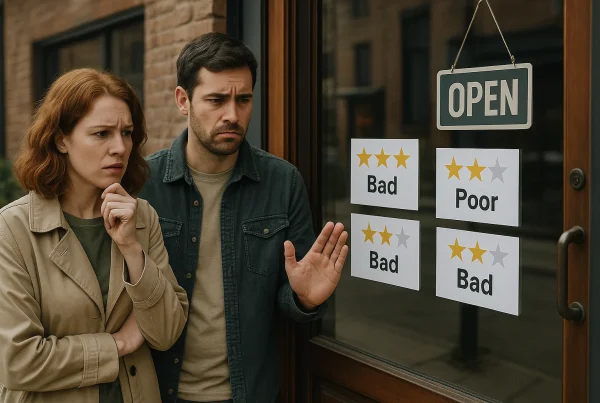
When a company enters an evaluation without pre-trust, the entire interaction is tilted.
Every claim requires more evidence. Every advantage needs more explanation. Ambiguity gets interpreted conservatively — against the company rather than in its favour. The buyer’s committee is not being unfair. They’re applying rational caution to a company they don’t yet have a frame for.
The sales cycle extends. The proposal requires more rounds of clarification. The negotiation is harder because the buyer hasn’t yet developed the trust that supports premium fees. And even when the deal closes — which it often does, because the work is genuinely strong — it closes more slowly, at a lower fee, with more friction than it needed to.
That cost, cumulative across a year’s pipeline, is significant. How brand friction adds months to the average B2B sales cycle is partly this: the absence of pre-trust forces the relationship to do the work that the brand should have done before the first meeting.
The Halo That Precedes the Meeting
McKinsey walks into a room and something happens that has nothing to do with the specific team or the specific recommendation.
The buyer recalibrates their expectations. They prepare differently. They listen differently. They interpret ambiguity in the firm’s favour. When the McKinsey team says something uncertain, the buyer assumes they’re being deliberately conservative. When a less familiar firm says the same thing, the buyer worries they don’t know.
Psychologists call this the halo effect — the tendency for a positive impression in one domain to spill across all others. In B2B procurement, the relevant halo is authority: the perception that a company operates at a level where their expertise doesn’t need to be proven from scratch in every engagement.
McKinsey has spent decades building that halo. Most companies haven’t — not because they can’t, but because they haven’t understood that this is a thing that can be built intentionally.
The hidden architecture of B2B trust isn’t accidental. The companies that consistently arrive pre-trusted have made specific, deliberate investments in the signals that precede the relationship.
Trust that forms before the meeting is the most commercially powerful kind — because it changes the entire frame of the evaluation. You’re no longer being assessed. You’re being confirmed.
The Brand Gravity Momentum Session™ maps the specific signals your company is sending before buyers meet your team — identifying where you’re building trust and where you’re eroding it.
What Pre-Trust Actually Looks Like in Practice
Three specific dynamics produce pre-trust in B2B contexts. All three are buildable.
Intellectual presence. Companies that have a body of thinking — published positions, named perspectives, a consistent point of view on the problems they solve — arrive in evaluations with a head start. The buyer has encountered their thinking before the pitch. They know roughly how this company approaches the world. That familiarity produces something close to confidence, even without direct experience.
This is why the power of authority marketing is so commercially significant for B2B firms. It’s not about content production for its own sake. It’s about ensuring that when a buyer finally encounters your company in an evaluation, they feel like they already know what kind of firm you are.
Signal congruence. Pre-trust collapses when signals are inconsistent. A company with a strong reputation gets introduced to a buyer, the buyer looks them up, and the website doesn’t match the description. Or the proposal arrives and the writing doesn’t reflect the quality of the conversation that preceded it. Each mismatch erodes the nascent trust faster than it was built.
How buyers judge your brand in the first few seconds is shaped almost entirely by whether the signals cohere. A coherent presentation — one where the website, the proposal, the conversation, and the people all tell the same story about the same kind of company — registers as reliability. Reliability is the foundation of trust.
Appropriate selectivity. Companies that are clearly for some buyers and not for others signal something important: they have standards. They believe their work is worth protecting. That signal produces aspiration rather than accessibility — and aspiration is a more powerful trust builder than availability.
The most dangerous sentence in business is “we can help anyone.” It reads as desperation. The companies that pre-trusted buyers gravitate toward are the ones that communicate, implicitly or explicitly, that they’re selective. They’re not available to everyone. The buyer feels they’re being evaluated as much as they’re evaluating.
The Companies Buyers Trust Before Meeting Them
Look at the professional services and B2B sectors where pre-trust is strongest.
Wachtell, Lipton, Rosen & Katz — 280 lawyers, one office, consistently retained for the highest-stakes M&A transactions in the world. Clients don’t arrive needing to be convinced Wachtell is credible. The evaluation is about fit and timing, not capability. That position took decades to build — but it was built, intentionally, through a very specific set of choices about what work to take, what territory to occupy, and what to refuse.
Ramboll, the engineering consultancy, arrived at a comparable position in specific infrastructure and environmental sectors. Not by being the largest firm in the room, but by producing thinking that the market encountered before any specific engagement began. Research, positions, frameworks — enough intellectual presence that buyers in target sectors felt they knew Ramboll’s approach before the firm had ever pitched to them.
Neither company arrived at pre-trust through marketing spend. They arrived at it through the clarity and consistency of their commercial position — and the deliberate investment in the signals that carry that position to buyers before the relationship begins.
The Pre-Trust Audit
This takes twenty minutes. Do it honestly.
Step 1: The stranger test. Ask someone who has never heard of your company to spend five minutes with your website. Then ask: “What kind of company is this, who is it for, and why would a serious buyer trust them?” Their answer is your current pre-trust signal — unfiltered.
Step 2: The intellectual presence check. Go to your /thinking page, your LinkedIn, your published positions. If a buyer researched your company for thirty minutes before a pitch, what would they understand about how you think about problems? Would they arrive with a sense of your perspective — or just your services?
Step 3: The consistency audit. Compare your website, your most recent proposal, your standard introductory email, and your LinkedIn company page. Do they tell the same story, in the same voice, at the same quality level? Rate consistency 1–5. Below 4: the signals are fragmenting trust rather than building it.
Step 4: The selectivity test. Read your positioning language. Does it describe who you’re for and who you’re not for — or does it try to appeal to the widest possible audience? Selectivity in language is a trust signal. Universality is a warning sign.
If two or more of these tests produce uncomfortable answers, your pre-trust architecture is working against you.
The Field Test
After your next five initial meetings, ask this question in the first ten minutes: “What did you know about us before today?”
Their answer tells you exactly what pre-trust signal preceded the meeting. If the answer is “not much, we found you through X” — you entered without ambient authority. If they reference something they read, a specific piece of thinking, a reputation in a specific territory — you entered with a head start.
The difference in those two conversations isn’t just a detail. It’s the difference between an evaluation where you have to prove yourself and one where you’re being confirmed.
Pay attention to what specifically they reference. The source of their pre-trust tells you which investments are working — whether it’s your published thinking, your positioning language, a specific reputation in a defined territory, or a trusted referral that gave them a precise description. Each source is a signal. Knowing which signals are landing tells you where to invest more.
Building the second kind of conversation consistently is what brand strategy actually produces, commercially. Not awareness for its own sake. Trust that precedes the room.
Pre-trust is built from signals that accumulate before any specific relationship begins. It’s not a shortcut — it requires deliberate investment. But companies that have it consistently win evaluations that feel unfair to the firms that don’t, because the game was already tilted before anyone sat down.
The Brand Gravity Momentum Session™ maps where your pre-trust signals are strong, where they’re inconsistent, and what specific investments would change the way buyers arrive at your first conversation.
HP DemandSignals™ — Strategic brand intelligence for business leaders. Read more at Highly Persuasive →