

There’s a test we run early in almost every diagnostic engagement. We ask five people inside the company — separately, without preparation — to answer a simple question: “What does this company do, and why should someone choose you over the alternatives?”
The answers are rarely the same. Sometimes they’re not even close.
One person leads with the product. Another leads with the company history. A third describes a capability that the company stopped offering two years ago. The sales director gives a polished, confident answer — but it doesn’t match the website. The CEO gives a different polished, confident answer — and it doesn’t match the sales director’s.
Nobody is wrong, exactly. But nobody is aligned.
And that misalignment — between what the website says, what the sales team says, what the proposals describe, what the LinkedIn profile claims, and what the client actually experiences — is one of the most commercially expensive problems a company can have. Not because inconsistency is a branding sin. Because inconsistency creates friction at every single point where a buyer is trying to make a decision.

What Inconsistency Actually Costs
Most companies think of brand consistency as a design issue — matching colours, using the right logo file, keeping the font consistent. That’s visual consistency, and it matters, but it’s the surface layer.
The consistency that affects revenue is narrative consistency: whether every touchpoint tells the same story about who the company is, what it does, and why it’s worth choosing.
When that story fragments, the cost shows up in four places:
Longer sales cycles. A buyer who encounters one story on the website and a different story in the sales meeting has to do extra work — reconciling the two versions, deciding which one to believe, asking clarifying questions that shouldn’t be necessary. Each moment of reconciliation adds time. Across a pipeline of 20-30 active opportunities, those moments compound into weeks of additional cycle time.
Weaker referrals. A satisfied client who can’t articulate a consistent version of what you do produces vague referrals — “they’re great, you should talk to them” — which convert at a fraction of the rate of specific ones. The language your clients use to describe you is only as clear as the language you’ve given them.
Higher discount rates. When a buyer can’t clearly see the difference between you and a competitor — because your own materials describe you differently depending on which touchpoint they encounter — price becomes the tiebreaker. Inconsistency erases differentiation. And erased differentiation invites negotiation.
Champion failure. Your internal advocate goes into the procurement meeting to make the case for choosing you. They’re working from memory, a one-pager, and whatever impression your brand created across the touchpoints they encountered. If those touchpoints told different stories, the champion’s case is fragmented before they open their mouth. The committee senses uncertainty. The deal stalls.
None of these costs appear on a dashboard. They show up as “the pipeline is slow,” “we keep losing on price,” “referrals don’t convert like they used to.” The symptom gets diagnosed as a sales problem, a marketing problem, a pricing problem — when the root cause is a consistency problem that nobody has measured.
Every touchpoint that tells a different story doesn’t just confuse the buyer. It makes every other touchpoint less effective — because the signals cancel each other out instead of compounding.
The Brand Gravity Momentum Session™ maps the signals your brand sends across every touchpoint and identifies where inconsistency is creating friction, extending cycles, and costing deals.
Why Inconsistency Happens (And Why It’s Nobody’s Fault)
Before diagnosing the specific failure modes, it’s worth understanding why this happens — because in most companies, inconsistency isn’t caused by negligence. It’s caused by growth.
A company starts with a founder who can tell the story perfectly. Every pitch, every proposal, every client conversation carries the same conviction and clarity. The brand is the founder’s narrative, and consistency is automatic because it flows from one source.
Then the company grows. A sales team is hired. A marketing person joins. The website gets redesigned — perhaps by an agency that wasn’t briefed on the founder’s actual positioning. Proposals are written by different people using different templates. The LinkedIn presence is managed by someone who wasn’t in the room when the strategy was set.
Each person adds their interpretation. Each touchpoint drifts slightly from the last. And over two or three years, the company that once told a perfectly coherent story is now telling five or six partially overlapping ones — each individually reasonable, collectively incoherent.
This is Brand Decay™ in action: Also known as Brand Erosion: the natural entropy that erodes every brand over time. It doesn’t require mistakes. It just requires growth without a system to hold the narrative together.

The Five Fracture Points
Inconsistency doesn’t show up everywhere equally. It concentrates at five specific points where the damage is highest.
1. The Website-to-Sales Disconnect
The buyer visits the website. They form an impression — of what you do, who you’re for, what level you operate at. Then they get on a call with your sales team, and the story shifts. Different emphasis. Different language. Different framing of the value.
The buyer notices. They may not say anything, but the inconsistency registers as a small uncertainty: “Which version is the real one?” That uncertainty doesn’t resolve itself. It sits in the background of every subsequent interaction, quietly raising the bar for trust.
Ramboll, the global engineering consultancy, discovered this fracture when they analysed messaging across 35 countries. The Copenhagen office described themselves as “sustainability consulting.” The Abu Dhabi office led with “environmental compliance services.” Same company. Same capability. Two different stories — each accurate, neither aligned. The confusion wasn’t internal. It was showing up in how clients and prospects described Ramboll to colleagues, which meant referrals were fragmenting across markets.
2. The Visual-Verbal Mismatch
Your website looks premium — clean design, confident layout, strong photography. Then the proposal arrives in a Word document with inconsistent formatting, clip art headers, and a different colour palette. Or the sales deck uses a template from three years ago that doesn’t match the current brand.
This mismatch triggers what psychologists call cognitive fluency — the ease with which the brain processes information. When visual signals are consistent, the brain processes them effortlessly, which registers as trust and competence. When they clash, the brain has to work harder, which registers as doubt.
The doubt is subtle. The buyer doesn’t think “this proposal looks unprofessional.” They think “something feels off.” And “something feels off” is one of the most dangerous buyer impressions in a competitive evaluation — because it activates the safety calculus without giving the buyer a specific objection they can articulate.
3. The Promise-Experience Gap
The website says “tailored solutions.” The initial engagement feels generic. The brand claims “strategic thinking.” The deliverable is a templated report. The About page says “senior-led.” The day-to-day contact is a junior coordinator.
This is the most destructive form of inconsistency because it erodes trust retroactively. Every previous touchpoint — the impressive website, the strong proposal, the confident sales meeting — gets reinterpreted through the lens of the experience. The buyer doesn’t just feel disappointed. They feel misled. And a buyer who feels misled doesn’t just leave. They warn others.
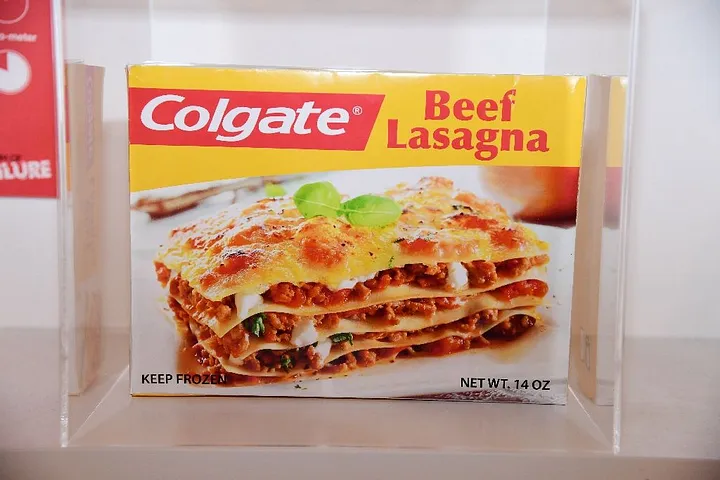
actual product from Colgate
The Colgate frozen lasagna debacle of 1982 remains the textbook case. Colgate — a brand synonymous with oral hygiene, mint freshness, and bathroom-cabinet credibility — launched a range of frozen meals. The product wasn’t bad. The brand was simply the wrong messenger. Consumers couldn’t reconcile “the company that cleans my teeth” with “the company that makes my dinner.” The promise-experience gap was so severe that the product was pulled almost immediately.
Most promise-experience gaps aren’t that dramatic. They’re subtler: a firm that positions as “strategic advisors” but sends invoices formatted like a freelancer’s. A consultancy that claims “deep sector expertise” but presents case studies from entirely different industries. Each gap is small. Together, they teach the buyer that the brand’s claims require verification — which is the opposite of trust.
4. The Internal Story Fragmentation
This is the fracture that starts inside and bleeds outward.
When the CEO describes the company one way, the sales team describes it another way, and the marketing team describes it a third way, the market receives a fragmented signal. Each version is a partial truth. None of them is the complete, aligned narrative that a buyer needs to form a clear impression.
Emerson Electric addressed this directly when they standardised the language their sales engineers used across divisions. Before the alignment work, each division described Emerson’s value differently — some led with products, some with services, some with outcomes. After establishing a shared vocabulary with a consistent hierarchy of messages, they measured improvement in pipeline velocity. The signal sharpened. The market responded.
The lesson: alignment doesn’t happen through a team meeting. It happens through a messaging architecture — a structured system that gives everyone the same story to tell, with enough flexibility to adapt to context but not enough latitude to contradict each other.
5. The Channel Personality Disorder
LinkedIn sounds authoritative. The website sounds corporate. The email newsletter sounds casual. Instagram (if it exists) sounds like a different company entirely.
Each channel was probably set up at a different time, by a different person, with a different brief. Over time, they’ve drifted into separate personalities — and the buyer who encounters two or three of them in the same evaluation process experiences the same dissonance as someone meeting a person who acts differently depending on who’s in the room.
The psychological principle here is expectancy violation theory: when an experience contradicts what we expect based on prior interactions, we don’t just notice the inconsistency — we penalise it. The buyer expected the LinkedIn authority to continue on the website. When it didn’t, the violation registered as a trust deficit that the brand has to work to recover.
Adapting tone across channels is smart — LinkedIn is more formal than Instagram. Changing personality across channels is damaging — because personality is the foundation of how trust forms, and trust cannot form on a shifting foundation.
The Signal Alignment Diagnostic
Score your brand across all five fracture points. For each, rate honestly: 1 (significant inconsistency) to 5 (fully aligned).
| # | Fracture Point | What You’re Scoring | Score (1-5) |
|---|---|---|---|
| 1 | Website ↔ Sales | Does the sales team’s verbal description match what the website communicates? | |
| 2 | Visual ↔ Verbal | Do proposals, decks, and documents match the visual quality and tone of the website? | |
| 3 | Promise ↔ Experience | Does the client experience match what the brand promised during the sales process? | |
| 4 | Internal alignment | Would five employees describe the company the same way? | |
| 5 | Channel consistency | Does your brand feel like the same company across website, email, social, and in-person? |
Score 21-25: Strong alignment. Your signals compound — each touchpoint reinforces the last. Protect this actively, because decay is always working against you.
Score 13-20: Partial alignment with meaningful gaps. Some touchpoints reinforce each other; others contradict. The buyer’s experience is uneven — which means your best marketing is being undermined by your weakest touchpoint.
Score 5-12: Significant fragmentation. The buyer encounters what feels like multiple companies depending on which touchpoint they hit. This level of inconsistency is actively extending sales cycles, weakening pricing conversations, and costing deals — and the cost is compounding every quarter it goes unaddressed.
What Alignment Actually Looks Like
The fix isn’t a brand guidelines document that sits in a shared drive unread. It’s a messaging architecture — a living system that provides:
A core narrative that everyone draws from. Not a script. A structure: who you’re for, what you do, why it matters, what makes you different, and what the outcome is. Specific enough to be consistent. Flexible enough to adapt to context.
A hierarchy of messages that cascades from positioning through to individual touchpoints. The CEO’s version. The sales team’s version. The proposal version. The email version. Each one tailored for the context, each one aligned with the same underlying story.
Proof standards that apply everywhere. If the website uses structured case studies with metrics and verification, the sales deck should too. If the proposal claims outcomes, those claims should match what the website publishes. Every touchpoint reinforcing the same evidence.
A voice that adapts without shapeshifting. Professional on LinkedIn. Conversational in email. Warm in person. But always recognisably the same company — the same values, the same perspective, the same level of intelligence. Tone shifts. Personality doesn’t.
When this system is in place, something remarkable happens: every investment in marketing, sales, and business development starts working harder. The website builds trust. The sales conversation deepens it. The proposal confirms it. The client experience validates it. Each touchpoint compounds the last — which is what Brand Amplification™ looks like in practice.
When the system is absent, those same investments cancel each other out. The website builds trust. The inconsistent proposal erodes it. The casual email undermines it. The buyer’s net impression is neutral at best, negative at worst — and the company can’t understand why their marketing “isn’t working” despite spending more every year.
The Field Test
Run the Signal Alignment Diagnostic. Score honestly.
Then do the five-person test: ask five people inside the company to describe what you do and why someone should choose you. Compare the answers. The variance between them is a precise measure of how much inconsistency is leaking into the market.
If the variance is high, you’ve found something that’s costing more than most companies realise — because every misaligned signal doesn’t just fail to help. It actively undermines every other signal you’re sending.
Consistency isn’t a design virtue. It’s a commercial multiplier. And the company whose signals align will always outperform the company that spends more but signals less coherently.
The most expensive marketing problem isn’t insufficient reach. It’s contradictory signals — where every touchpoint undermines the last instead of building on it.
The Brand Gravity Momentum Session™ audits the signals your brand sends across every touchpoint — website, proposals, sales conversations, case studies, and digital presence — and identifies where inconsistency is creating friction that your analytics can’t see.
HP Field Notes — Strategic brand intelligence for business leaders. Browse more at Highly Persuasive →