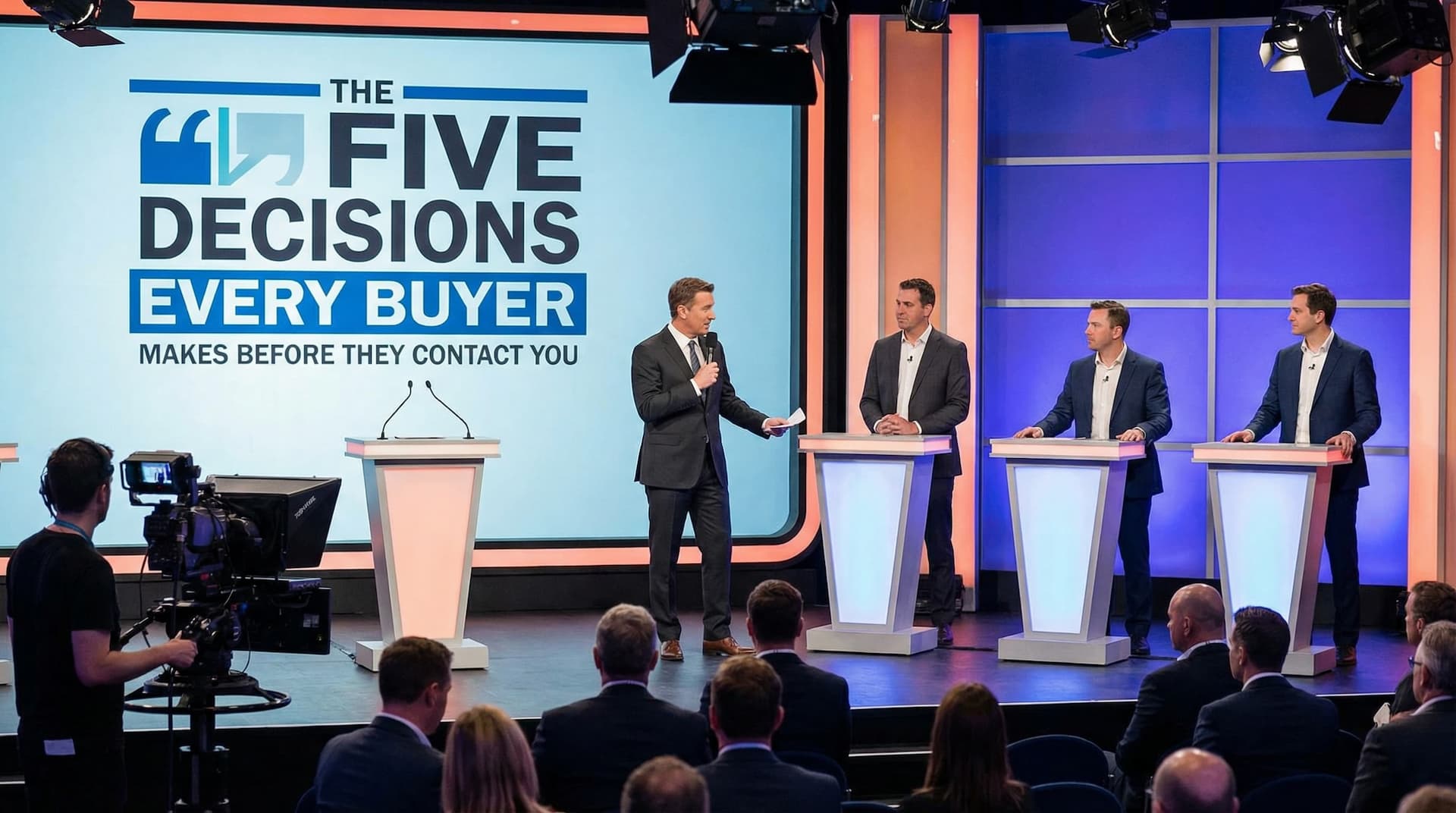

Five Decisions Every Buyer Makes Before They Contact You
By the time a prospect picks up the phone, sends the email, or fills out the contact form, the most consequential part of the buying process is already over.
You heard that right. Not the negotiation. Not the evaluation. Not the procurement scoring.
The framing — the set of assumptions, impressions, and conclusions the buyer has reached about who you are, what you’re worth, and whether you belong on the shortlist. They judge the book by the cover, rightly or wrongly.
Gartner’s research on the modern buying journey confirms what every experienced salesperson already senses intuitively: buyers now complete roughly 74% of their decision process before engaging with a vendor directly. And that was before AI.
By the time your sales team gets involved, the buyer has already decided what kind of company you are, what category you belong to, what price range feels reasonable, and whether you’re a serious option or a courtesy inclusion.
These aren’t conscious, deliberate judgments.
They’re fast impressions formed across a handful of touchpoints — your website, your LinkedIn presence, a referral’s description, a case study, a piece of content they encountered three months ago. Each touchpoint contributes a fragment. Together, the fragments form a picture.
If the picture is clear, specific, and commercially compelling, the first sales conversation starts on favourable ground. If the picture is vague, generic, or contradictory, the sales team spends the first meeting undoing impressions that formed before they entered the room.
Here are the five decisions the buyer has already made.
Decision 1: Category
“What kind of company is this?”
Before evaluating whether you’re good, the buyer categorises you. This happens in seconds — often based on the first touchpoint they encounter.
Are you a large consultancy or a boutique? A strategic firm or an execution shop? A specialist or a generalist? A premium provider or a mid-market option?
The category the buyer assigns determines everything that follows. It sets the comparison set (who you’ll be evaluated against), the price expectation (what feels reasonable), and the evaluation criteria (what they’ll look for in your proposal).
Once a buyer files you in a category, changing that classification is extraordinarily difficult. Psychologists call this the anchoring effect — the first piece of information received disproportionately shapes all subsequent judgments. If your website, your LinkedIn, or a referrer’s description leads the buyer to categorise you as “a small marketing agency,” every subsequent touchpoint is interpreted through that frame — even if your actual capability is strategic consultancy.
The commercial implication: the signals you send before the first conversation determine the comparison set you’re evaluated within. Get categorised correctly, and you’re compared against appropriate peers. Get categorised wrong, and you spend the entire sales process trying to re-anchor — which is an uphill battle that most companies lose.
What controls this decision: Your website’s first impression. Your LinkedIn headline and summary. How referrers describe you. The visual quality of your brand relative to your claimed market position.
Decision 2: Relevance
“Is this company for someone like me?”
Category tells the buyer what you are. Relevance tells them whether you’re for them.
A buyer scanning your website is asking a very specific question: “Do these people understand my situation?” They’re looking for signals of familiarity — industry language, relevant case studies, examples that mirror their context, problems described in terms they recognise.
When those signals are present, the buyer moves forward. When they’re absent — when the website is too broad, too generic, or too focused on a different sector — the buyer concludes “this isn’t for me” and moves on. The capability might be perfect. But if the signal doesn’t match the buyer’s mental model of their own situation, relevance is lost.
This is where specificity creates its enormous advantage. A structural engineering firm that says “we solve complex problems” gives the buyer nothing to match against. The same firm saying “we specialise in seismic retrofit for pre-1970s commercial buildings” gives the buyer an immediate relevance signal — or an immediate disqualification, which is equally valuable because it frees up attention for better-fit prospects.
What controls this decision: Industry-specific language on your website. Case studies from the buyer’s sector. Proof structured with context specificity — who the client was, what they faced, how it relates to what this buyer faces.
By the time a buyer contacts you, they’ve already decided what category you’re in, whether you’re relevant, and roughly what you should cost. The sales conversation doesn’t set these impressions. It inherits them.
The Brand Gravity Momentum Session™ audits every pre-contact touchpoint and identifies where the buyer’s five decisions are forming — and whether they’re forming in your favour.
Decision 3: Credibility
“Can I trust this company to deliver?”
The buyer has categorised you correctly and sees relevance. Now they need to answer a harder question: is this company credible enough to risk my time (and eventually my budget and my reputation)?
Credibility at this stage isn’t built through claims. It’s built through signals — specific, verifiable, and structured.
The proof hierarchy applies here with full force. At the bottom: vague claims (“we deliver exceptional results”). In the middle: social proof (logos, testimonials). At the top: structured outcomes with context, metrics, methodology, and a verification path. The buyer’s credibility assessment is determined by the highest level of proof you provide — and most companies stop at the middle.
The psychology underneath this is the representativeness heuristic: the buyer judges the quality of your future work based on the quality of what they can evaluate now. If your case studies are vague narratives, they assume your thinking is vague. If your case studies are specific, structured, and commercially grounded, they assume your work will be too. The evidence isn’t just proving past results. It’s signalling future quality.
What controls this decision: Case study quality and structure. Specificity of claims. Methodology visibility. Whether the buyer can verify outcomes independently.
Decision 4: Price Frame
“What should this cost?”
Before receiving a proposal, the buyer has already formed a price expectation. That expectation anchors the entire negotiation — and it’s shaped not by your pricing, but by every signal your brand has sent up to this point.
A website that looks like a boutique consultancy anchors the buyer at boutique consultancy rates. A website that looks like a freelancer anchors at freelancer rates. A proposal that arrives with structured methodology and outcome data anchors at strategic engagement rates. A proposal that arrives in a plain Word document anchors at commodity rates.
The mismatch between price expectation and actual price is where most discounting pressure originates. When the brand signals “mid-market generalist” and the proposal says “$85,000,” the buyer experiences sticker shock — not because $85,000 is unreasonable, but because the anchor was set lower by every prior touchpoint.
This is the mechanism behind why margins shrink even when the work gets better. Operational quality improved. The brand signals didn’t. The price anchor stayed low. And the sales team has to fight against that anchor in every negotiation — a fight they frequently lose through discounting.
What controls this decision: Visual quality of website and materials. Positioning specificity. Proof structure. Whether pricing is framed against the cost of the buyer’s problem or presented as a standalone number.
Decision 5: Shortlist Inclusion
“Should I contact them — or keep looking?”
This is the decision that determines whether you get a conversation at all. The buyer has formed impressions across category, relevance, credibility, and price. Now they make a binary choice: include or exclude.
The exclusion is almost never dramatic. The buyer doesn’t think “this company is bad.” They think “I have enough options” — and you didn’t make the cut. Not because of any single failure, but because the cumulative impression across the first four decisions didn’t create enough gravity to pull them forward.
The inclusion threshold varies by how many options the buyer has. In a crowded category with strong alternatives, the threshold is high — your signals need to be very clear, very specific, and very compelling. In a specialised niche with fewer alternatives, the threshold is lower. But in every case, the threshold is crossed before the buyer makes contact — which means the quality of your pre-contact signals determines the quality and volume of your pipeline.
What controls this decision: The cumulative effect of every touchpoint. But most critically: whether the buyer can clearly articulate — to themselves or to a colleague — why you’d be worth a conversation. If they can, you make the shortlist. If they can’t, you’re forgotten before the evaluation formally begins.
The Pre-Contact Audit
Score your brand against each of the five decisions. For each, ask: if a qualified buyer encountered my brand cold — through a web search, a referral, or a LinkedIn visit — what decision would they reach?
| # | Decision | Question to Ask | Score (1-5) |
|---|---|---|---|
| 1 | Category | Would the buyer categorise us correctly — at the level and in the type of firm we actually are? | |
| 2 | Relevance | Would a buyer in our target sector immediately see signals that we understand their world? | |
| 3 | Credibility | Does our proof go beyond claims and logos to structured, specific, verifiable evidence? | |
| 4 | Price frame | Do our brand signals anchor the buyer at a price level that matches what we actually charge? | |
| 5 | Shortlist | Could a buyer explain to a colleague, after visiting our website, why we’d be worth a meeting? |
Score 21-25: Your pre-contact signals are working. Buyers arrive at the first conversation with accurate expectations and genuine intent. Your sales team is operating on favourable ground.
Score 13-20: Some decisions are forming well; others are forming against you. The sales team is spending significant time correcting impressions that should have been set before the meeting.
Score 5-12: The buyer’s pre-contact decisions are working against you systematically. Your pipeline is smaller than it should be (decision 5), your sales conversations start from the wrong place (decisions 1-3), and your pricing power is being undermined before the proposal is even written (decision 4).
What Changes When You Control the Five Decisions
When a company deliberately engineers the signals that shape these five decisions, the commercial effect is immediate and measurable.
Inbound quality improves. Buyers who arrive having formed the correct category, relevance, and credibility impressions are pre-qualified. The first conversation is about fit and scope — not about education and persuasion.
Sales velocity increases. The sales team isn’t spending the first meeting correcting misimpressions. They’re building on a foundation that was laid by the brand. The conversation starts further along the decision path, which compresses the cycle.
Pricing holds. When the price anchor is set correctly before the proposal arrives, the number feels proportionate. The negotiation shifts from “why is this so expensive?” to “what does this include?” — a fundamentally different and more productive conversation.
The pipeline broadens. Buyers who would have excluded you — not because you weren’t qualified, but because the pre-contact signals were too vague to justify a conversation — now include you. The shortlist expands without any change to your marketing spend. The signals did the work.
The Field Test
Run the Pre-Contact Audit. Score honestly.
Then try this: ask a colleague outside your industry to spend 30 seconds on your website and answer five questions — one for each decision. What category are we? Are we relevant to [target sector]? Are we credible? What would they expect this to cost? Would they shortlist us?
The gap between the answers they give and the answers you’d want them to give is the measure of how much revenue you’re losing before the first conversation ever happens.
Seventy percent of the buying decision happens before your sales team gets involved. The question is whether your brand is shaping that 70% — or leaving it to chance.
The Brand Gravity Momentum Session™ maps every pre-contact signal your brand sends and identifies where the five buyer decisions are forming against you — so the first sales conversation starts on ground you’ve chosen.
DemandSignals™ — Strategic brand intelligence for business executives, founders & leaders. Browse more at Highly Persuasive →