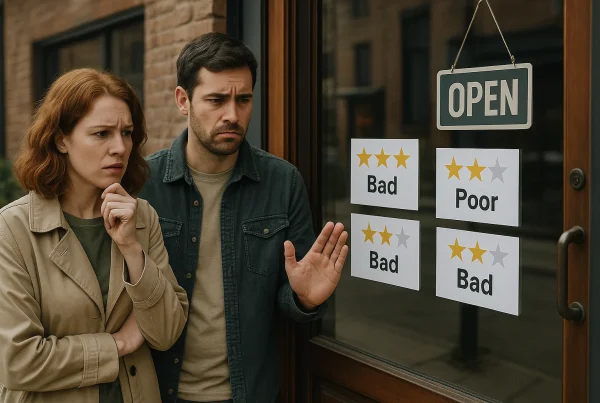
Price isn’t your enemy. Belief is. Competing on price is a symptom. Competing on conviction is strategy.
Because in serious B2B decisions, buyers don’t choose what’s better. They choose what’s safer to believe in.
The Wall Every Smart Business Hits
Every founder eventually hits this wall:
“We know we’re better. Why do they still pick the cheaper option?”
And the answer—if you’re honest—hurts more than you expect.
It’s not because your offer is weak.
It’s because the buyer doesn’t believe it’ll work for them.
- They’ve been burned.
- They’ve heard the pitch.
- They’ve got a boss asking, “Why this one?”
And if your brand doesn’t arm them with an answer better than “it was the cheapest,” they’re going to fold.
This isn’t about pricing strategy. It’s about perception engineering.
Because in high-consideration buying, people don’t pay for promises. They pay for clarity, confidence, and cover.
And the best way to give them that?
Make your offer feel like the only thing they’d feel stupid not doing.
You’re Not Building a Pitch Deck. You’re Building a Defense Slide
Most companies build their positioning like a pitch deck. Great ones build it like an internal justification slide.
There’s a difference.
“Why did we go with them?”
You need to give your buyer that answer—before anyone even asks.
And it can’t be “price.” That works in procurement. It fails in politics.
Especially when the real cost isn’t what you charge—It’s what the business loses when they delay.
Why Smart Buyers Don’t Care About Your Features
Think about the last time you bought something big.
You didn’t compare features. You probably didn’t even care if it was objectively better.
Just like buyers that use 5 subconscious mental models to filter your company in the decision making process.You bought the thing that made you feel like:
“These people have clearly done this before—for people like us. They see the problem the same way we do. If this doesn’t work, it’s not because we picked wrong—it’s because we were too late.”
That’s belief.
It’s not built with more benefits. It’s built with strategic alignment—not just function, but frame.
Your Real Competitor Isn’t Price—It’s Internal Doubt
Here’s a stat that should keep most sales teams up at night:
🔹 64% of B2B buyers say they “actively avoid sales calls until they’ve formed a strong internal argument for the purchase.”
Translation? If your brand doesn’t do the pre-sale belief building, they’ll pick the option that’s safest to defend—not the one that’s best to use.
Which means your biggest competitor isn’t another vendor.
It’s internal doubt.
3 Questions That Will Redefine Your Entire Pitch
Now ask yourself:
- Where in your pitch are you asking the buyer to “trust you” instead of giving them a frame they can use?
- What part of your messaging is explainable to a CFO in one sentence?
- Have you made it so easy to justify choosing you that they don’t even think to ask about price?
Or are you just hoping the product will carry the weight?
Because here’s the lesson:
In B2B, pricing is what they bring up when belief hasn’t been built properly.
Don’t Manufacture Urgency—Build Inevitable Logic
You don’t need urgency. You need inevitability.
You don’t need a “limited-time offer.”
You need a buyer saying:
“We’re wasting time not fixing this. Let’s just do it now.”
You want to kill price resistance? Tell the story of a client who didn’t move fast enough.
Don’t sell a product.
Sell the cost of being the person who had the warning and waited anyway.
Insert This Line in Your Next RFP Response
Quick tip that’s worth 5 figures in some sectors:
If you’re competing in RFPs, stop answering questions like a vendor.
Write one paragraph—somewhere in the proposal—that says:
“Most providers in this category are stuck in feature wars and low-bid cycles. That’s fine. But we don’t win because of price. We win because of results that are easier to defend in front of a boardroom.”
That one line disqualifies the tire-kickers and builds swagger with decision-makers.
Sell Your Lens—Not Your Product
If you want pricing power, stop arguing for your product.
Start arguing for your lens. That’s the sharpest thing you can sell.
A way of seeing the problem so clearly that the buyer feels seen, validated, and out of excuses.
You’re not competing on service. You’re competing on certainty.
The Strategy Session That Rebuilds Belief
If you’re not sure where your brand is leaking belief, we built this for you:
🔍 ConversionPsychology™ 80-Point Growth Audit & Strategy Session
We don’t just look at your copy.
We look at your clarity. Your frames. Your mental model alignment.
We map out the psychological friction that keeps smart buyers from saying yes—so you can fix it at the root.
✅ 8 friction zones from price defense to pitch trust
✅ Teardown format. No fluff. No checklists.
✅ Results you can implement or hand off immediately
Because you don’t beat cheap by yelling louder. You beat cheap by making buyers say:
“We’d be insane not to do this.”